How to read the evidence and directory names →
CJC-1295 with DAC: Scientific Perspectives
Human research on long-acting CJC-1295 showed increases in growth hormone and IGF-1. That does not prove anti-aging benefits or validate no-DAC products by association. [6]
Mechanism, evidence and interpretation
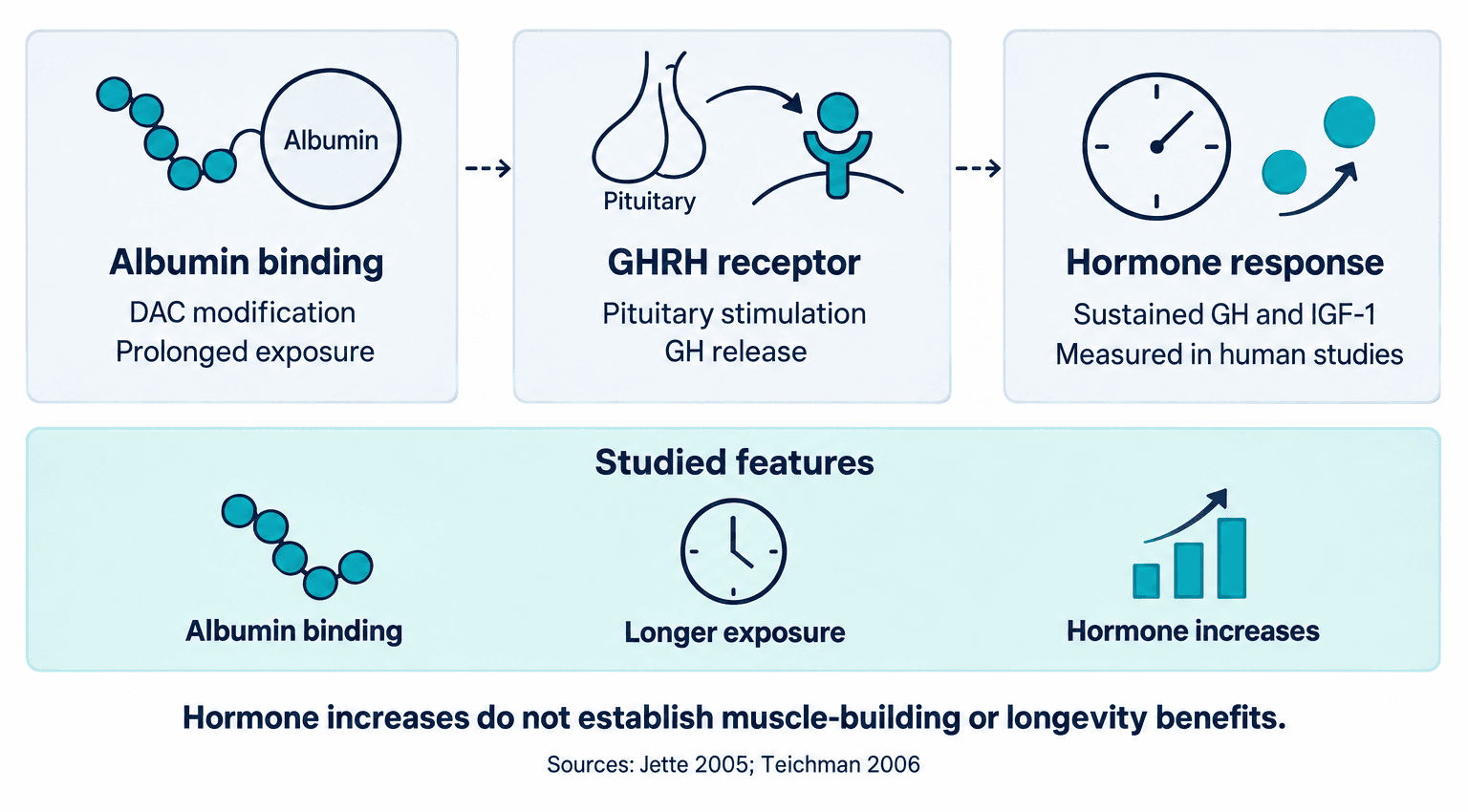
The compound acts through the growth-hormone-releasing hormone pathway. Its drug affinity complex () promotes binding to circulating , prolonging exposure. This distinguishes long-acting CJC-1295 from modified GRF 1–29, commonly sold under the name CJC-1295 without DAC.
Human research on long-acting CJC-1295 showed increases in and . That does not prove anti-aging benefits or validate no- products by association. [6]
In two short randomized studies in healthy adults, the long-acting compound had an estimated of 5.8–8.1 days, with sustained GH and responses. These are pharmacodynamic outcomes, not proof of improved recovery or longevity. They cannot be assigned to modified GRF 1–29. [6]
For research design, the form permits investigation of prolonged - stimulation and sustained hormone exposure. A human study found increased mean and trough GH concentrations with preserved secretion after long-acting CJC-1295. Duration of drug exposure and the pattern of hormone secretion are therefore separate variables. [48]
Sources: [6] Long-acting CJC-1295 in healthy adults; [48] Ionescu M and Frohman LA. Pulsatile secretion of growth hormone (GH) persists during continuous stimulation by CJC-1295, a long-acting GH-releasing hormone analog. J Clin Endocrinol Metab. 2006;91:4792–4797. https://pubmed.ncbi.nlm.nih.gov/17018654/
A modified hormone-release signal
CJC-1295 with is the long-acting form associated with the original CJC-1295 clinical research. It is a synthetic of , the signal that encourages cells to release . The DAC modification is designed to link the molecule to in blood. Albumin binding changes the time course of exposure, allowing the release signal to remain active longer than an unmodified, rapidly degraded peptide.
This identity should be distinguished from products sold as CJC no DAC, often discussed as modified GRF 1-29. The names overlap in catalogs, but the pharmacology and evidence cannot simply be combined. The generic CJC-1295 page explains the directory's mixed variant history. This page concerns the -binding form. A source that does not identify the modification is incomplete for the purpose of applying a long-acting study's findings.
Why duration changes the hormone response
A short-lived release signal creates a different exposure pattern from one carried by a blood protein. The long-acting design maintains stimulation of the while the body's other regulatory signals continue to operate. It does not supply directly. The must still be capable of responding, and the wider feedback system influences what happens. Longer exposure is therefore a description of drug behavior rather than a guarantee of a better clinical outcome.
The original human research found sustained changes in and . Another study used repeated overnight sampling to examine pulse patterns. It found continued pulses together with an increased background hormone level. This matters because saying the pulses remained intact can otherwise sound as though nothing else changed. The system was stimulated, and its average exposure changed. Understanding that distinction is more informative than describing the compound only as a natural hormone booster.
Human evidence and its boundaries
The randomized CJC-1295 trials were short studies in healthy adults, with biochemical measurements as central outcomes. They were suitable for exploring and hormone responses. They were not designed to establish years of safety, treatment of a diagnosed deficiency, improvement in frailty or prevention of age-related disease. A rise in shows that the intervention reached a biological pathway, but the usefulness of that rise depends on the clinical question.
Longer-acting compounds also require interpretation over time. A dose can influence exposure beyond the moment it is administered, and repeated dosing may create a different pattern from a single exposure. This is why a preparation's duration, study schedule and monitoring cannot be detached from one another. Published hormone-response results should not be converted into a universal regimen. Claims about body composition or recovery need direct evidence using those endpoints and the same defined product.
Comparison with other release compounds
Sermorelin is a shorter -related peptide, while ipamorelin activates the pathway. Tesamorelin has a distinct clinical development history and a specific labeled use. These differences explain why evidence for one compound does not validate another. A catalog's grouping under support is a topic category, not proof of equivalent action, risk or benefit. The exact molecule and the actual study outcome should lead the comparison.
How the growth hormone system works
The system is a conversation between several organs. The , a small region at the base of the brain, sends signals to the . One signal, , encourages growth hormone release. Another, , restrains it. and related signals can also affect release. The pituitary does not normally produce one steady hormone level. It releases pulses, whose size and timing change with sleep, age, nutrition and other conditions. This explains why one isolated blood measurement can be difficult to interpret.
acts directly on some tissues and also encourages production of in the liver and elsewhere. These signals influence growth, protein turnover and the use of stored energy. The same network also affects blood glucose. A compound that raises a hormone measurement has therefore changed a real biological system, but the measurement alone cannot tell us whether someone became stronger, recovered from an injury, or lived longer. Those are separate outcomes that require separate studies.
It helps to distinguish three intervention points. A asks the to release hormone through the GHRH . A receptor reaches the release system through a different receptor. An analog acts further downstream, rather than simply asking the pituitary to work harder. These differences matter when comparing sermorelin, ipamorelin and IGF-1 LR3. Similar marketing descriptions do not make these substances interchangeable.
Feedback also matters. Circulating hormones can reduce further stimulation, and can change their response during repeated exposure. A stronger initial response does not guarantee a stronger continuing benefit. Body composition measurements need careful reading too: includes water and other nonfat tissues, not just contractile muscle. A trial should therefore report functional outcomes, such as measured strength or walking ability, alongside hormone levels and body composition. Without that context, a biochemical change can sound much more useful than the evidence actually demonstrates.
Timing also changes what a measurement means. A peak concentration describes one moment, while overall exposure describes a period of time. Sampling immediately after a stimulus can produce a different impression from sampling between pulses. Researchers may therefore use repeated blood draws rather than one isolated result. This does not make every high value desirable; it makes the interpretation more precise. For a release-pathway compound, the relevant question is how the intervention changes the pattern and whether that change produces an outcome that matters, compared with an appropriate control group.
How to read the research and dosing record
The dosing record above and this article serve different purposes. The record preserves source amounts and schedules. The article explains identity, biology and evidence. An archived schedule is not a clinically validated prescription, and a calculation cannot decide whether a compound is suitable for a person. Keep the exact molecule, , route and strength attached to any research claim. Do not treat an animal experiment as a human dosing instruction or transfer a prescription product's instructions to a different vial.
When checking a paper, first identify who or what was studied. Then check the comparison group, the measured outcome, the length of follow-up and reported adverse effects. A laboratory marker and a patient benefit are different endpoints. Small exploratory studies can help generate a hypothesis, while larger controlled studies can test it more reliably. Internal compound links provide comparisons, and the dotted terms open short definitions with links to the site's glossary. The source links below let you check the original context rather than relying on a headline.
Key facts
SOURCE DATA- Molecular formula
- —
- Molecular weight
- —
- CAS number
- —
- Sequence
- —
- Half-life
- 5.8–8.1 days in the cited human DAC study; not applicable to no-DAC products.
- Form
- —
- Storage
- —
- Vial sizes
- —
— Information not supplied or not yet published.
Article sources
- [6] Long-acting CJC-1295 in healthy adultsSupplied guide: primary study or official product information; interpret in context
- [48] Ionescu M and Frohman LA. Pulsatile secretion of growth hormone (GH) persists during continuous stimulation by CJC-1295, a long-acting GH-releasing hormone analog. J Clin Endocrinol Metab. 2006;91:4792–4797. https://pubmed.ncbi.nlm.nih.gov/17018654/Supplied guide: primary study or official product information; interpret in context
- Teichman et al. (2006): CJC-1295 hormone responses in healthy adultsTwo short randomized, placebo-controlled human trials; hormone endpoints
- Ionescu and Frohman (2006): GH pulses during CJC-1295 exposureSmall human physiology study; not a clinical recovery trial
- [2] Jetté et al. — Identification of CJC-1295 as a long-lasting GRF analog (2005)
- [3] FDA — December 2024 evaluation of CJC-1295 forms (2024)
Research discussion 0
Share a source, ask a question, or add context. Every comment is reviewed before it appears publicly.
Explore the peptide forum → for dedicated threads and nested conversations.
Save your research and join the conversation.
Sign in to comment