SOURCE PROTOCOL
About this compoundGHK-Cu · 100 mg / 5 mL BAC water
Vile Size: 100 mg. Added liquid: 5 mL; BAC water (source assumption).
Reported amount: 1.7 mg.
Reported schedule: Daily, 5 times per week
Loading page…
COMPOUND OVERVIEW
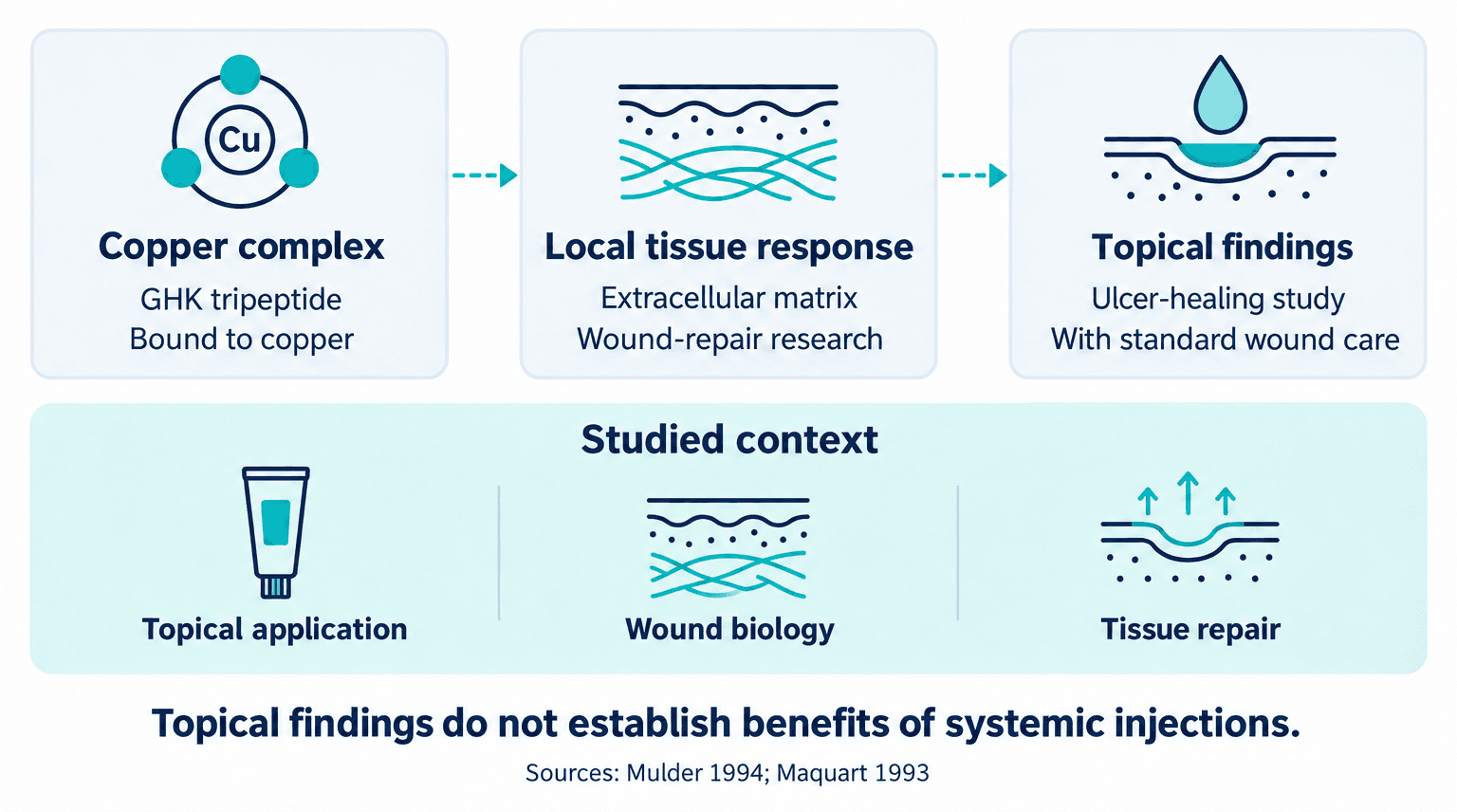
GHK-Cu is a small peptide attached to copper, studied for its role in skin biology and tissue remodeling. Researchers examine how it affects and other materials that provide structure around cells. Imagine a tissue as a building with a supporting framework: GHK-Cu is investigated for messages that may influence the maintenance crew working on that framework. Its effects depend on the tissue, and way it is delivered.
SOURCE REFERENCE
Current aggregated data suggests the following information:
Each row shows a separate source example for GHK-Cu.
Bacteriostatic water is a source assumption. Amounts and schedules are not independently verified or personal medical advice. Consult a qualified clinician.
| Peptide per Vial (mg) | BAC water | Dose | U-100 syringe | Frequency |
|---|---|---|---|---|
| 50 mg | 3 mL | 1.7 mg | 10 UNITS | Daily, 5 times per week |
| 100 mg | 5 mL | 1.7 mg | 8 UNITS | Daily, 5 times per week |
Calculated doses are derived from the source UNITS and assume added liquid equals final volume. U-100 UNITS measure volume, not drug activity. Source UNITS may be rounded or differ from an explicit dose; see the detailed source protocol below.
Amounts, schedules, and preparation - organized and summarized from current aggregated data
Vile Size: 100 mg. Added liquid: 5 mL; BAC water (source assumption).
Reported amount: 1.7 mg.
Reported schedule: Daily, 5 times per week
Vile Size: 50 mg. Added liquid: 3 mL; BAC water.
Reported amount: 1.7 mg. Reported schedule: Daily, 5 times per week.
Source mass amounts and schedules are retained. Reviewed syringe conversions use the stated preparation; unresolved conversions are labeled unavailable. Not personal medical advice. Consult a qualified clinician for decisions about personal use.
How to read the evidence and directory names →
Laboratory findings help explain interest in skin applications. They do not establish whole-body benefits from injections; formulation and route matter. [10]
In cell experiments, it influences production and other parts of the supporting material around cells. Copper binding is part of its chemistry, but it is not simply a copper supplement.
Laboratory findings help explain interest in skin applications. They do not establish whole-body benefits from injections; and route matter. [10]
Separate normal biological function from the effects of administering extra compound. Record the route, , tissue studied and clinical endpoint. Findings from oral, topical, nasal or injected exposure should not be transferred between routes without supporting evidence.
GHK means glycyl-histidyl-lysine, a peptide made from three . GHK-Cu refers to its association with copper. The peptide has been identified in human plasma and investigated in tissue-related biology. The copper complex and the peptide without copper are related but distinct preparations. Studies should identify which one was used rather than treating every copper-peptide product as chemically identical.
Copper is a trace element involved in normal activity. A molecule's ability to bind copper can change how the metal is presented in an experimental system. That does not establish that administering more copper or a copper complex always improves tissue health. The exact concentration, chemical state and influence interpretation. A cosmetic ingredient name alone does not answer these questions.
An early -culture study reported stimulation of synthesis after exposure to GHK-Cu. Fibroblasts are cells that produce parts of the , the supporting network around cells. The finding helps explain the compound's association with wound-repair and skin research. It does not demonstrate that an injection produces younger skin or repairs every damaged tendon.
A later rat wound-chamber experiment examined accumulation of connective-tissue components in a controlled setting. This adds an animal context, but the exposure was closely connected to the experimental wound. It should not be treated as evidence for an unrelated systemic schedule. quantity also needs interpretation: tissue strength and appearance depend on organization, remodeling and location, not simply on producing more of one protein.
A topical is intended to act through contact with skin, while an injected preparation reaches the body through a different route. The amount delivered to a relevant tissue may differ substantially. Stability, binding and local conditions can also affect a copper-peptide complex. A study of a cream therefore cannot validate the dose or safety of an injection, and a cell experiment cannot establish either product's clinical performance.
The same caution applies to hair-related claims. Related copper peptides can have different amino-acid sequences, and a paper about another molecule should not be presented as direct GHK-Cu evidence. A useful cosmetic study would identify the actual ingredient and , use an appropriate comparison and measure a meaningful change. Claims about wound healing, pigmentation, hair growth and whole-body rejuvenation are separate outcomes that require their own support.
The best-supported starting point is that GHK-Cu can influence connective-tissue-related measurements in experimental systems. That is more precise than saying it reverses aging. The laboratory findings provide a reason for continued research, while questions about the route, clinical result and long-term exposure remain essential. Normal occurrence of a peptide in the body is not proof that an externally supplied preparation is harmless at any amount.
Compare BPC-157 for different experimental repair pathways and glutathione for another small peptide with distinct biology. GHK-Cu also appears in GLOW and KLOW. Those mixtures require evidence about their actual ingredients and proportions, rather than a collection of unrelated single-ingredient results. Keeping the molecular identity, route and outcome together makes the profile easier to read and harder to mistake for a broad treatment promise. The archived schedule does not remove those evidence boundaries.
Tissue repair is a coordinated process rather than a single switch. After injury, the body limits bleeding, recruits immune cells and clears damaged material. Cells then move into the area, produce supporting proteins and rebuild parts of the tissue. Later, remodeling changes how those proteins are arranged. A wound that closes quickly is not necessarily as strong, flexible or functional as the original tissue. Skin, tendon, muscle, cartilage and intestinal lining also have different structures and healing requirements.
are cells that help build the , the network surrounding cells. is an important part of that network, but more collagen is not always better. Its organization, location and turnover matter. Excess or poorly organized matrix can produce or scarring. Similarly, supplies new blood vessels, which can support a healing wound. Increased vessel growth is not universally helpful in every organ or disease. A pathway associated with repair needs to be understood in its particular setting.
Laboratory studies can examine individual pieces of this process. Researchers may measure cell movement, a signaling protein, a gene transcript, or tissue appearance under a microscope. These measurements help identify possible mechanisms. They do not automatically show that an injected product will heal a human tendon, prevent surgery or improve athletic performance. The experiment may use concentrations that cannot safely be achieved in people, or deliver the substance directly to tissue instead of through the route advertised for a vial.
Blends add another question: what happens when ingredients are combined? Separate positive findings for BPC-157, GHK-Cu or a thymosin-related molecule do not establish the effectiveness of a mixture. The components may reach tissues differently, affect overlapping signals or have problems. A credible blend study needs to identify the actual molecules, their proportions and the preparation tested. It should compare the blend against suitable controls and measure meaningful recovery. Until then, descriptions such as healing, regeneration and synergy remain hypotheses rather than dependable treatment outcomes.
The dosing record above and this article serve different purposes. The record preserves source amounts and schedules. The article explains identity, biology and evidence. An archived schedule is not a clinically validated prescription, and a calculation cannot decide whether a compound is suitable for a person. Keep the exact molecule, , route and strength attached to any research claim. Do not treat an animal experiment as a human dosing instruction or transfer a prescription product's instructions to a different vial.
When checking a paper, first identify who or what was studied. Then check the comparison group, the measured outcome, the length of follow-up and reported adverse effects. A laboratory marker and a patient benefit are different endpoints. Small exploratory studies can help generate a hypothesis, while larger controlled studies can test it more reliably. Internal compound links provide comparisons, and the dotted terms open short definitions with links to the site's glossary. The source links below let you check the original context rather than relying on a headline.
— Information not supplied or not yet published.
Original source fields are preserved here for reference. They are not independently verified.
The requested reference lists 1.7 mg and 8 U-100 UNITS. At the stated concentration, 1.7 mg corresponds to 8.5 UNITS; confirm the intended rounding.
The requested reference lists 1.7 mg and 10 U-100 UNITS; 10 UNITS corresponds to approximately 1.67 mg under the stated volume assumption.
Source-reported quantities and schedules are educational comparisons, not verified administration instructions. Route, diluent compatibility, vial capacity, final volume and clinical suitability are unverified. Added liquid is assumed to equal final volume only for arithmetic. U-100 UNITS measure volume; drug activity IU is a separate unit.
Source-reported quantities and schedules are educational comparisons, not verified administration instructions. Route, diluent compatibility, vial capacity, final volume and clinical suitability are unverified. Added liquid is assumed to equal final volume only for arithmetic. U-100 UNITS measure volume; drug activity IU is a separate unit.
Source reference for research and education. Not personal medical advice. Amounts and clinical suitability are not independently verified. Conversion checks are labeled below.
Research discussion 0
Share a source, ask a question, or add context. Every comment is reviewed before it appears publicly.
Explore the peptide forum → for dedicated threads and nested conversations.
Save your research and join the conversation.
Sign in to comment